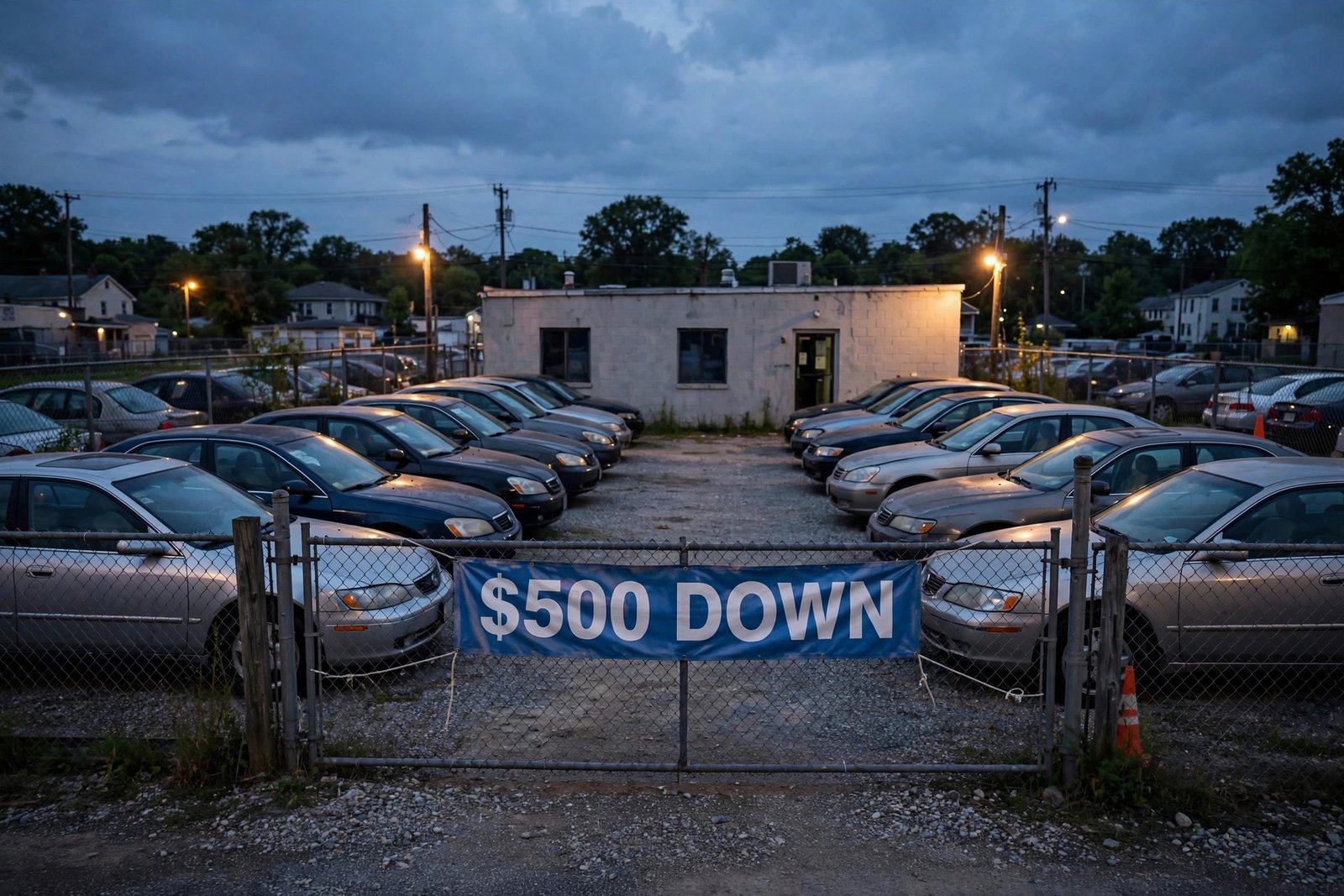
You need a car to get to work, and your credit is damaged, thin, or non-existent. Then you see the sign: “$500 down — no credit check — everyone approved.”
Dealers making that offer exist in almost every U.S. city. But “$500 down” is only the entry fee, not the price of the car, and “no credit check” does not mean “no requirements” or “guaranteed approval.” This guide explains how these deals work, what you will really pay, what dealers will ask for, the warning signs to walk away from, and the cheaper alternatives worth trying first.
What “$500 Down, No Credit Check” Actually Means
Most dealers advertising this way are “buy here, pay here” (BHPH) lots: you buy the car there, and you pay there. The dealer is both seller and lender — unlike a conventional dealership, which passes your application to a bank, credit union, or finance company. With no outside lender to say no, these lots can work with buyers a bank would decline.
According to the Consumer Financial Protection Bureau (CFPB), dealers that advertise “no credit check” or “buy here, pay here” typically finance loans in-house for people with no credit or poor credit. The trade-off is cost: rates at these dealers tend to run higher than rates from banks, credit unions, or other lenders.
What “no credit check” does — and does not — mean
It usually means the dealer will not base its decision on a traditional credit-bureau pull or score the way a bank would. It does not mean no application, no proof you can afford the payments, approval for any car at any price, or a promise the deal will help your credit score.
How a $500-Down Deal Usually Works, Step by Step
- You choose from the dealer’s own used-car inventory — usually older, higher-mileage used cars. You cannot bring a car from another lot.
- You apply in-house, providing identification and proof of income and address (see the checklist below). The dealer often decides on the spot.
- You pay the down payment. The advertised $500 is often a minimum; the amount required can rise depending on the car, your income, and any deferred down payment arrangement.
- You sign a retail installment contract naming the cash price, amount financed, APR, finance charge, payment schedule, and total of payments. This document — not the ad — is the deal.
- You pay the dealer directly. Payments are commonly monthly, but some dealers schedule them weekly or every two weeks to match paydays. Ask exactly how, when, and where payments are due.
- The dealer keeps a lien on the title until you finish paying. Miss payments, and it can repossess under your state’s rules — often faster than you might expect.
Why the $500 figure can grow at signing
The advertised $500 rarely covers everything due on day one. Budget also for sales tax, title, and registration fees, a documentation fee where charged, your first insurance payment, and a possible “deferred” payment — a second chunk of the down payment due a week or two later. Ask for the total due at signing, in writing.
What Dealers Typically Require
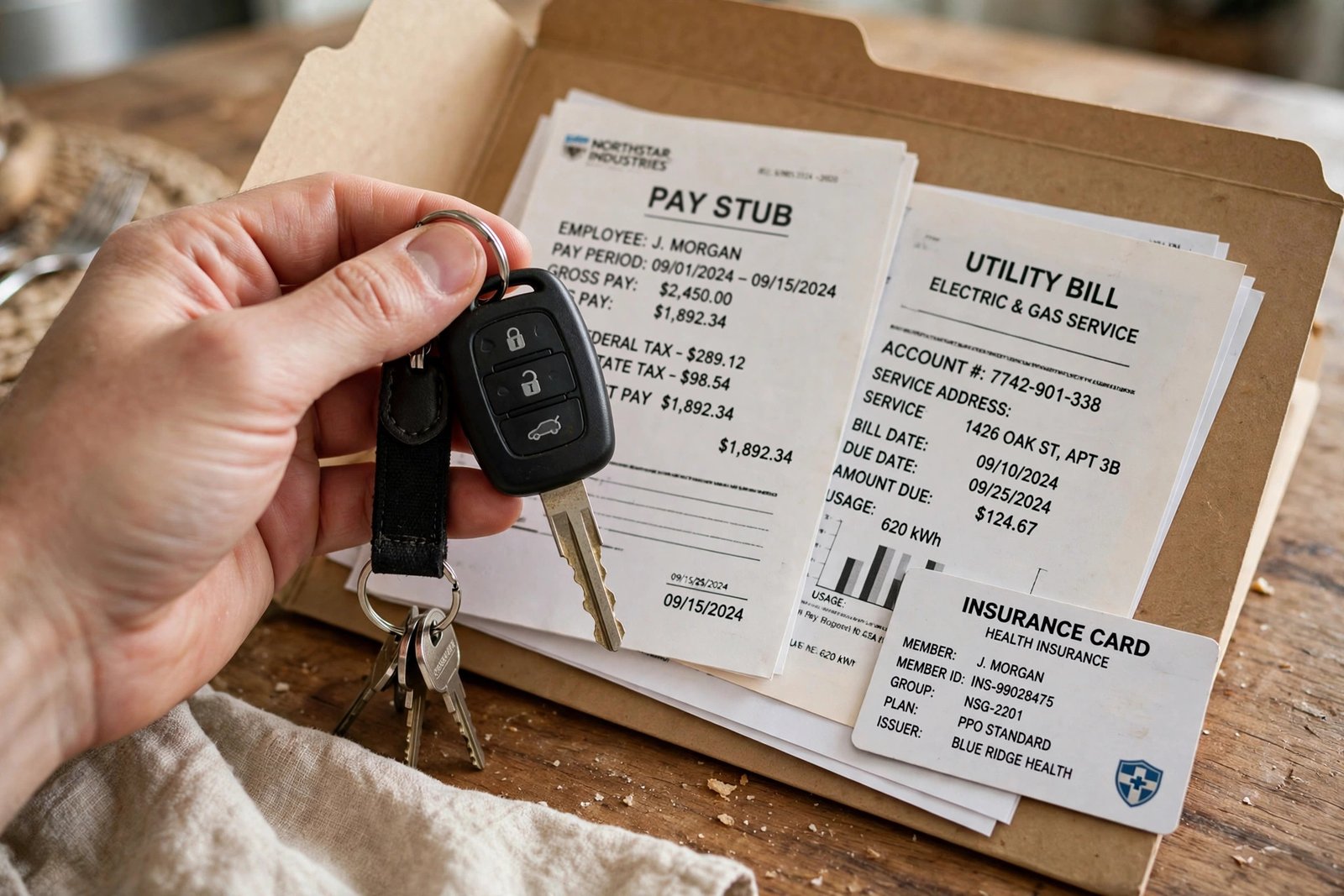
Because the dealer skips the credit check, it leans harder on everything else:
- Government-issued photo ID, usually a valid driver’s license
- Proof of income — recent pay stubs are most common; self-employed or benefits-income buyers may be asked for bank statements or benefit letters
- Proof of residence — a recent utility bill, lease, or similar document in your name at your current address
- Proof of insurance, or the ability to buy it before driving off. Many in-house lenders require comprehensive and collision (“full”) coverage for the whole loan, which costs more than liability-only cover
- Personal references — names, addresses, and phone numbers (often several), used to locate you if you move or stop paying — so warn the people you list
- A working phone number, and sometimes proof of it
- The down payment, plus money for fees and insurance
Minimum income thresholds vary by dealer and by car. Be wary if you are offered far more car than your income comfortably supports — the dealer gets paid either way, including through repossession and resale.
The Real Cost: Why $500 Down Can Mean $12,000 for a $9,000 Car

The down payment is the smallest part of this purchase — the APR, term, marked-up price, and add-ons decide what you actually pay.
APR: the number that matters most
For context: Experian reported that in Q2 2026 the average used-car APR was 19.10% for subprime borrowers (scores 501–600) and 21.62% for deep-subprime borrowers (scores 300–500), compared with 6.29% for super-prime borrowers (781 and above). BHPH pricing sits at the expensive end of that market.
A worked example (illustrative, not a quote)
Say the car is priced at $9,000, you put $500 down, and you finance $8,500 over 36 months:
- At 20% APR: about $316 per month, $11,372 in payments, plus your $500 down = about $11,872 total — roughly $2,872 of it is interest.
- At 25% APR: about $338 per month, $12,167 in payments, plus $500 down = about $12,667 total.
- The same loan at 9% APR (a rate a credit union might offer a stronger borrower): about $270 per month, $9,731 in payments — roughly $2,100 less than at 20%.
That is before tax, title, fees, insurance, maintenance, and add-ons. The CFPB’s core advice applies doubly here: compare the total cost, not just the monthly payment, and shop around before you commit.
Other costs built into many BHPH deals
- Marked-up car prices. The same car can cost more at a BHPH lot than at a conventional lot, because the financing — not the sticker — is the product being sold. Check its value in a pricing guide first, and remember that frequent weekly or biweekly payments make a payment look small while the total stays high.
- Add-ons and service contracts. Optional products added at signing increase the amount financed and the interest you pay on it; the CFPB flags add-ons as a source of costly surprises.
- Repairs. Many BHPH cars are sold “as is” or with a short, limited warranty. A major repair on a car you still owe $7,000 on is the most common way these deals collapse.
More from our Vehicle section: Byron Thomas Williams Vehicle Licensing Penalties 12-Month Operator Ban.
GPS Trackers and Starter-Interrupt Devices: Know Before You Sign
Some subprime and BHPH contracts include a payment-assurance device: a GPS unit, a starter-interrupt device (sometimes called a “kill switch”), or both — letting the lender track the car and prevent it from starting if a payment is missed.
This is documented territory, not a rumor. In 2023, the CFPB sued auto-loan servicer USASF Servicing, alleging it had wrongly activated starter-interrupt devices thousands of times, including on borrowers who were not in default. State rules differ: some restrict these devices or require disclosure and consent.
You may not be able to refuse the device and keep the deal. Do ask whether the car has one, get the activation rules in writing, and ask about warnings before a disable and any fee. Never sign a contract mentioning a device you were not told about.
Will It Rebuild Your Credit? Maybe Not
Many BHPH dealers advertise themselves as a path to rebuilding credit, but the CFPB cautions that they often report only negative information — such as late payments — and not your on-time payments. In that arrangement, two years of perfect payments does nothing for your score, while one late payment harms it.
Before you sign, ask: “Do you report all my payments, on-time as well as late, to Equifax, Experian, and TransUnion?” If yes, get that commitment in writing, as the CFPB advises. If the answer is no or vague, do not count credit-building as a benefit of the deal.
Red Flags and Scams to Avoid
Walk away — there is always another lot — if you see any of these:
- “Guaranteed approval for everyone.” No legitimate lender can promise this.
- Pressure to sign today because “this car will be gone” or “this price ends in an hour.”
- A refusal to give you the APR, finance charge, and total of payments in writing before signing. A dealer who hides figures that must appear in your contract is hiding them for a reason.
- A monthly payment quoted with no term attached. “$250 a month” means nothing until you know for how many months, at what APR, and for what total.
- “As is” pressure combined with no independent inspection. The Federal Trade Commission (FTC) recommends having a used car inspected by an independent mechanic and checking its history with a vehicle history report before you buy. A dealer who blocks an inspection is telling you something.
- Yo-yo financing: a call days later saying the financing “fell through,” so you must sign a worse contract or return the car. With true in-house financing the dealer is the lender, so be especially suspicious of this script.
- Verbal promises — about repairs, warranties, credit reporting, or removing a GPS device — that never make it into the written contract. Get promises in writing; spoken promises are hard to enforce.
Questions to Ask Before You Sign Anything
Take this list with you — a reputable dealer will answer every question plainly.
- What is the cash price, and the out-the-door price including tax, title, and all fees?
- What is the APR, finance charge, amount financed, and total of all payments?
- How many payments are there, how often are they due, and what happens if I am a few days late? Is there a grace period and a late fee?
- Is any part of my down payment deferred? When is it due, and what happens if I miss it?
- Is the car sold “as is” or with a warranty? What does the Buyers Guide say, and what does any warranty cover, for how long?
- Does the car have a GPS tracker or starter-interrupt device? When can it be used?
- Do you report my on-time payments to all three credit bureaus? Will you put that in writing?
- When can the car be repossessed, and what would I still owe afterward, including any deficiency balance?
- Can I have the car inspected by my own mechanic and see a vehicle history report first?
- Can I take a copy of the full contract home to read before signing? (If not, your answer to the deal should be no too.)
Also check the Buyers Guide: under federal rules dealers must display one on every used car, stating whether it is sold “as is” or with a warranty and what share of repair costs the dealer will pay. There is no general federal three-day right to cancel a car purchase — once you sign, you are usually committed.
Smarter Alternatives to Try First
A BHPH deal may still be the right call if you need a car immediately and have exhausted other routes. But try these first:
1. Get a credit-union pre-approval anyway
Credit unions often work with members whose credit is imperfect, and a pre-approval costs nothing but an application. Even if the rate is not low, one written offer gives you a market benchmark to compare the BHPH contract against. The CFPB recommends shopping for a loan before shopping for a car for exactly this reason.
2. Save a larger down payment, even briefly
Putting $2,500 down instead of $500 on that $9,000 car at 20% APR cuts the amount financed to $6,500, drops the payment to about $242 a month, and saves roughly $675 in interest. It also shrinks the gap between what you owe and what the car is worth — the gap that traps buyers when a car breaks down or is repossessed.
3. Buy a cheaper car with cash
A reliable $3,000–$4,000 car bought outright has no APR, no repossession risk, no forced full-coverage insurance, and no tracker. It will not be glamorous, and you should still pay for an inspection and history report, but for many buyers it is the strongest option financially.
4. Build credit in parallel, cheaply
Pay bills on time, keep credit-card balances low, consider a secured card or credit-builder loan from a credit union, and check your credit reports for errors you can dispute. Six to twelve months of this can move you into credit-union territory for your next car, at a fraction of the interest cost.
The Bottom Line
“$500 down, no credit check” is a door-opener, not a discount. These deals can put a car in front of someone a bank turned down — sometimes the difference between keeping a job and losing one. But the true price is set by the APR, the marked-up price, the fees, the insurance requirement, and the repossession terms. Go in knowing the total cost, in writing, before you sign — and if a deal only works when you do not look at it closely, it does not work.
Frequently Asked Questions
Can I really get a car with $500 down and no credit check?
Often, yes — buy-here-pay-here dealers finance in-house and base decisions mainly on income, residence, and your down payment rather than a credit score, according to the CFPB. But “$500 down” is usually a minimum, approval is never guaranteed, and tax, fees, and insurance are extra.
What do I need to bring to a no-credit-check dealer?
Typically a valid photo ID or driver’s license, recent pay stubs or other proof of income, proof of residence such as a utility bill or lease, proof of insurance (or money to buy it), personal references, and your down payment. Requirements vary by dealer.
Will a buy-here-pay-here loan improve my credit score?
Not necessarily. The CFPB notes that many of these dealers report only negative information, like late payments, and not on-time payments — so paying on time may not raise your score, while a late payment can lower it. Ask whether on-time payments are reported, and get the answer in writing.
Can the dealer disable or track my car if I miss a payment?
Some contracts include GPS tracking or starter-interrupt devices that can prevent the car from starting after a missed payment, and the CFPB has taken enforcement action over devices being activated wrongly. Rules vary by state, so ask whether your car has one and get the activation conditions in your contract.
What happens if I can’t keep up the payments?
The dealer can repossess the car under state law and your contract, and you may still owe a deficiency balance if it sells for less than you owe — plus you lose your down payment and payments already made. Contact the dealer early, keep records, and check your rights with your state attorney general’s office.