
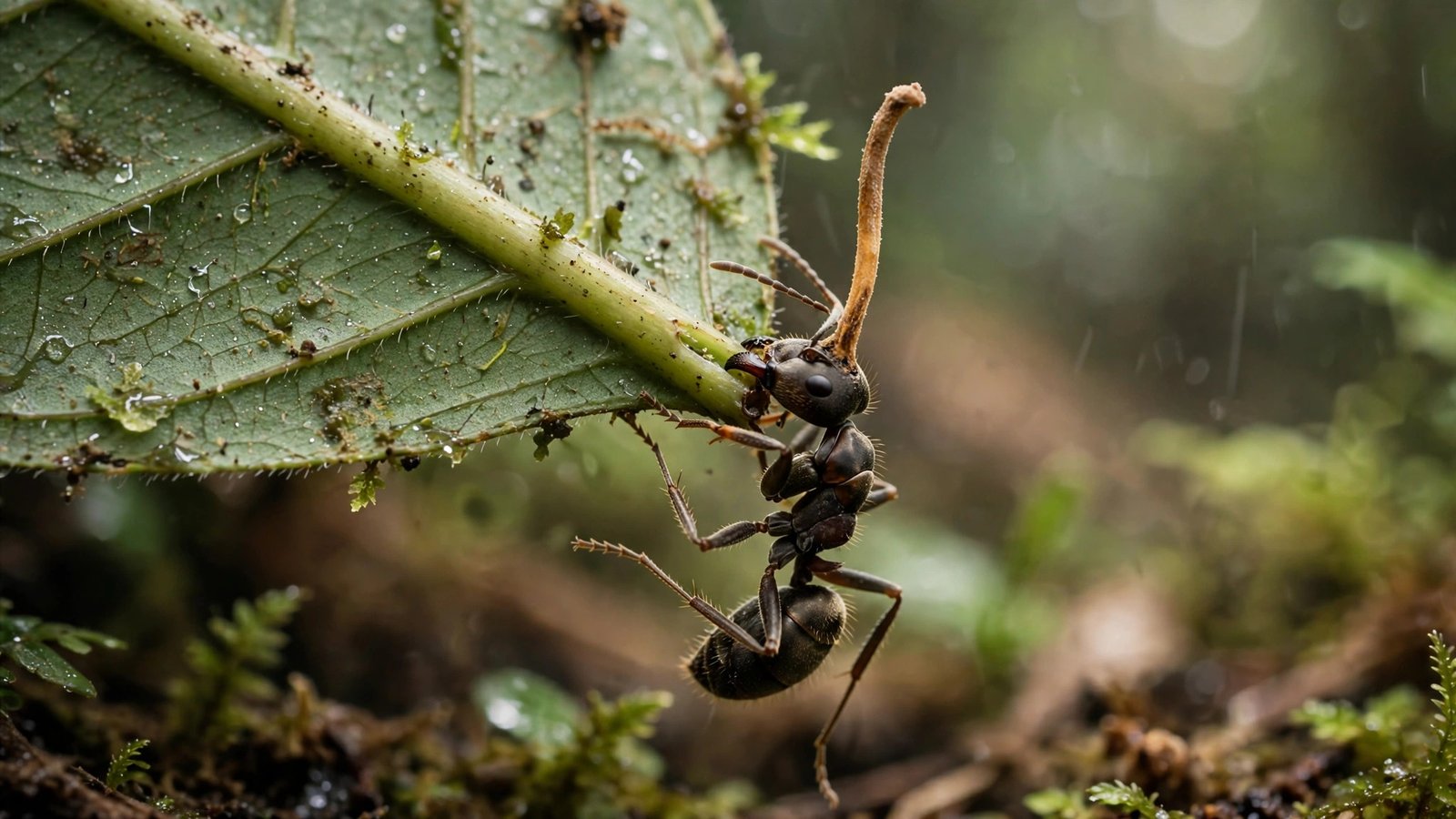
In a tropical forest, a carpenter ant leaves its nest in the canopy and does something no healthy ant should do. It wanders off the trail, trembles, climbs a small plant, bites hard into a leaf vein, and never lets go.
The ant is not choosing this. Inside its body, a parasitic fungus is finishing a life cycle refined over millions of years — and that final bite is what the fungus needs to reproduce.
That fungus is the zombie ant fungus, Ophiocordyceps unilateralis. It inspired the infected in The Last of Us, but the real biology is stranger, more precise, and — for humans — far less threatening. This guide explains what it is, how it manipulates carpenter ants, where it is found, how it controls an ant without invading its brain, and why it cannot infect people.
What Is the Zombie Ant Fungus?
The zombie ant fungus is a parasitic fungus that infects ants, changes their behaviour in very specific ways, and then kills them in a position that helps the fungus spread.
Its scientific name is Ophiocordyceps unilateralis. You will also see Ophiocordyceps unilateralis sensu lato, meaning “in the broad sense.” That wording matters, because what was once treated as a single species is now understood to be a complex of many closely related species, each adapted to a particular ant host.
Key facts at a glance:
- Scientific name: Ophiocordyceps unilateralis (species complex)
- Former name: Once placed in the genus Cordyceps, so it is still often called simply “cordyceps”
- Main hosts: Carpenter ants in the genus Camponotus
- Where it lives: Mainly tropical forests around the world
- Effect on the host: Behaviour manipulation, a final “death grip” bite, then death
- Risk to humans: None — it does not infect humans
Naturalist Alfred Russel Wallace encountered its effects in 1859, and the manipulation is ancient: a 48-million-year-old fossil leaf bears the bite scars left by manipulated ants. Scientists call this an “extended phenotype” — at the end of infection, the ant’s actions serve the fungus’s genes, not its own survival. See Encyclopaedia Britannica’s overview of the zombie-ant fungus.
Where Is the Zombie Ant Fungus Found?
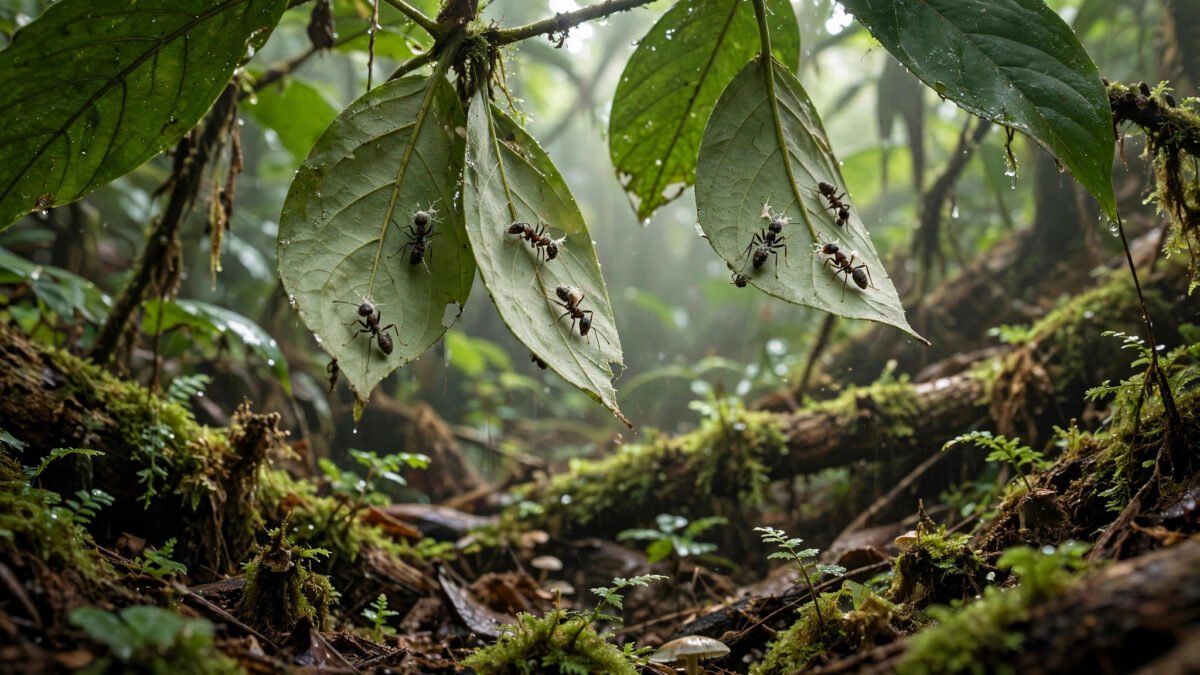
The zombie ant fungus is mainly pantropical. It is best studied in Thailand’s rainforests, where the classic host Camponotus leonardi lives in the canopy, and in Brazil’s forests, where researchers have mapped “graveyards” of dead ants. It also occurs in other tropical forests in Asia, Africa, and the Americas where suitable Camponotus ants live.
It needs warmth and, above all, humidity. The understory just above the soil is cooler and far more humid than the canopy — exactly the microclimate the manipulation pushes the ant into. Related Ophiocordyceps species occur in warm temperate forests, where infected ants more often bite twigs. The genus is large — more than 200 described species infecting insects and spiders — but ant-manipulating behaviour belongs to a smaller subset.
The Life Cycle, Step by Step
1. A spore lands on a carpenter ant
The cycle starts on the forest floor, where sticky spores settle in the path of foraging ants. Carpenter ants normally travel in the canopy, but gaps in their trails sometimes force them to the ground — their moment of danger.
If a spore sticks to a passing ant, it germinates, producing thread-like hyphae that push through the exoskeleton using pressure and enzymes that soften the cuticle. No bite or wound is needed. Contact is enough.
2. The fungus grows through the body — and hides
Once inside, the fungus spreads as single, yeast-like cells in the ant’s blood-like fluid (haemolymph). It feeds on internal tissues, suppresses immune and stress responses, and invades muscle in the legs, body, and head. For much of this period the ant appears normal — unusual, because colonies normally expel ill nestmates, a defence called social immunity.
Timing varies, but in well-studied cases infection to final bite takes roughly two to three weeks, with the behavioural switch coming once the fungal mass is large enough — about 16 to 24 days in cases summarised by Britannica.
3. The fungus manipulates the ant to climb vegetation
Then the ant’s behaviour breaks from the colony pattern completely. An infected ant:
- Leaves the nest at unusual times and fails to follow established pheromone trails
- Becomes unresponsive to other ants and to outside stimuli
- Suffers irregular, full-body convulsions that can knock it from the canopy to the forest floor
- Wanders in a seemingly aimless, unsteady way through the understory
The outcome is not random. The ant is steered toward low vegetation, roughly 25 centimetres (about 10 inches) above the ground, where the air is cool, shaded, and humid. That height is ideal for the fungus: high enough for falling spores to spread over trails below, and sheltered enough for the fungus to grow without drying out.
4. The “death grip” bite on a leaf vein
At the end of the climb comes the one act the fungus needs most. Typically around solar noon, when the timing appears synchronised in many studied populations, the ant turns onto the underside of a leaf, aligns itself along the main vein or midrib, and bites down with extraordinary force.
This is the death grip. The jaws lock and do not open again — not even after death. The locked bite anchors the corpse to the plant for weeks, holding it in exactly the humid spot the fungus selected. Without it, the body would fall, be scavenged, or dry out, and the fungus would fail. Death follows very shortly after the bite.
5. The ant dies and a fruiting body grows from its head
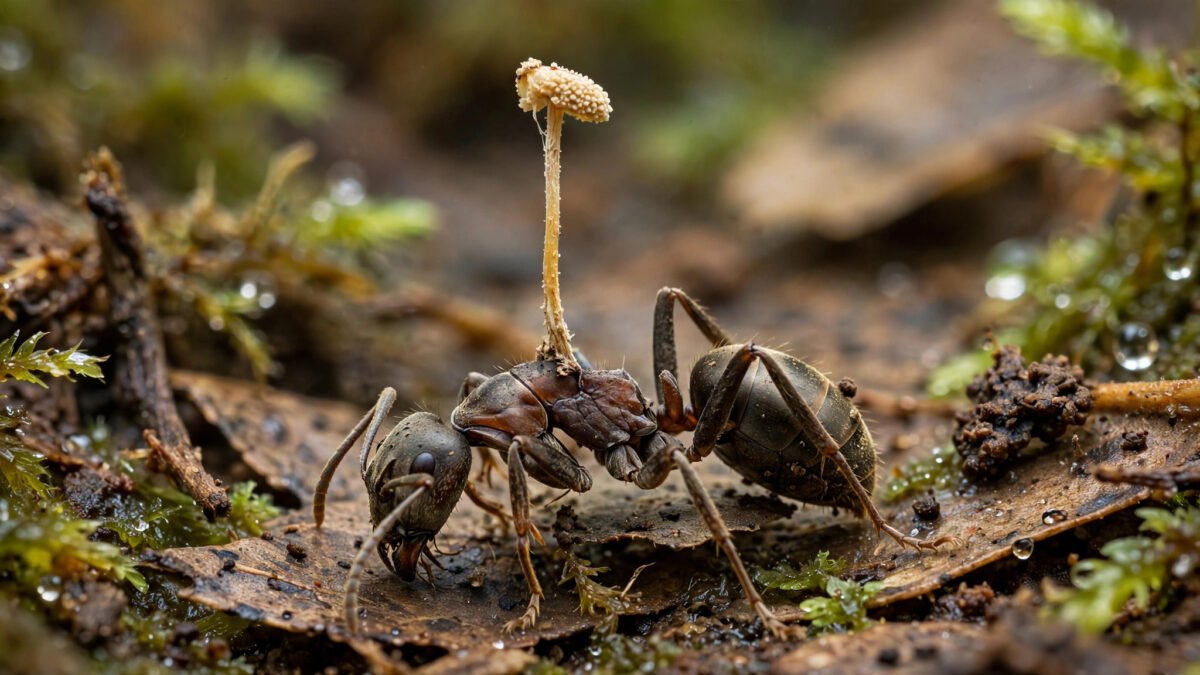
After death, the fungus consumes the soft tissues while reinforcing the exoskeleton from within, keeping the body intact as a protective case, and produces antimicrobials to fend off competing microbes.
Several days later comes the image most people recognise: a stalk — the fruiting body, or stroma — pushes out from the back or base of the head. It matures, develops spore-producing structures on its sides, and releases fresh spores onto the forest floor below, where the next foraging ant may walk through them.
Nature is not the only place unlikely engineers are at work — see how a 3D printed house gets built, layer by layer, by a giant printer instead.
How Does the Fungus Control the Ant? Not by Taking Over Its Brain
For years the simple explanation was that the fungus grows into the ant’s brain and rewires it. Current research says the reality is different — and more unsettling.
What Penn State researchers found
In a 2017 Proceedings of the National Academy of Sciences study, a Penn State-led team used advanced 3D microscopy to map fungal cells inside a manipulated ant at the moment of the death grip. They found fungal cells almost everywhere — head, thorax, abdomen, and legs — many connected into a three-dimensional network around the muscles. But they found none inside the brain itself.
As Penn State’s research report on the study explains, the fungus controls the host from the periphery, surrounding and invading muscle fibres. Lead researcher David Hughes compared it to a puppeteer working a marionette’s strings. Leaving the brain intact is likely practical: the fungus still needs the ant to walk, climb, and bite accurately at the end.
Chemicals, genes, and muscle damage
Muscle invasion is only part of the mechanism. Research summarised by Britannica points to three overlapping tools: neuromodulatory chemicals (including sphingosine and guanobutyric acid) released near the nervous system; gene switching, turning ant immune and stress genes down; and direct penetration of muscle fibres, disrupting contraction. How these are coordinated is still being worked out, but the correction to the popular story is clear: the fungus does not need to flood the brain to produce zombie-like behaviour.
A 2019 Penn State-led study in the Journal of Experimental Biology explains the death grip itself: the jaw muscles were extensively colonised and hypercontracted — contracted so forcefully that the filaments inside the fibres were damaged. It is not a bite the ant chooses to hold. The jaw muscles are driven into one final contraction and cannot release.
Not One Fungus, but Many: The Species Complex
The name can mislead if read as a single, general-purpose parasite. In the broad sense — sensu lato — it is a complex of many species, each tightly matched to one host ant species, as work by João Araújo and colleagues has shown. A fungus adapted to one Camponotus species in Thailand does not simply transfer to a different ant species elsewhere. Each pairing reflects very long co-evolution — hypothesised at roughly 45 million years. About 35 Ophiocordyceps species are known to manipulate host behaviour this way, with possibly hundreds more undiscovered.
Ants also fight back: they groom off spores, avoid the forest floor and known graveyards, and carry infected nestmates away. The fungus has its own enemy — a hyperparasitic fungus that attacks it and effectively castrates it, leaving only about 6.5 percent able to produce viable spores in one field study. That helps explain why only a few ants in a colony are infected at any one time.
Can the Zombie Ant Fungus Infect Humans?
No. Scientists’ answer is consistent: it does not infect humans, and there is no realistic route by which it could. Two reasons together are decisive.
1. Extreme host specialisation
Each species evolved to infect one specific ant species; its chemistry and manipulation are tuned to that ant alone. João Araújo, quoted in National Geographic and Smithsonian Magazine coverage, has stressed that moving to mammals would require millions of years of genetic changes — and even a jump between ant species is difficult. Fungal geneticist Ian Will has called an ant-to-human jump science fiction, and David Hughes, who advised The Last of Us game, has called a human takeover implausible.
2. Human body temperature
Ants are cold-blooded, at roughly forest temperature — the 20 to 30°C range this fungus thrives in. Our core temperature, around 37°C (98.6°F), is too hot for it to survive. As mycologist Bryn Dentinger explained to NPR, at that temperature its proteins cannot hold together and function. Warmth shields us from most fungi generally: of millions of estimated fungal species, only a few hundred cause disease in people, mostly in those with weakened immune systems. Humans also have no exoskeleton to drill through, and far more complex nervous and immune systems.
You cannot catch it by touching an infected ant or visiting a tropical forest. Cordyceps supplements are different, unrelated species.
Zombie Ant Fungus vs. The Last of Us: What the Show Gets Right and Wrong
The Last of Us — first a 2013 video game, then the HBO series from 2023 — is why most people know this fungus. Its creators were inspired by a BBC Planet Earth segment showing a real Ophiocordyceps infection, and David Hughes advised on the game.
What it borrows from reality: a real fungus really does manipulate a living host (the show’s infected are alive, not undead); infected ants really do climb, bite, and die fixed in place before a stalk grows from the head; and fungal cells inside a single ant really do link into a network around its muscles.
What it invents:
- Human infection and speed: Its mutated cordyceps jumps to humans almost overnight. In reality that would need millions of years of evolution, if possible at all.
- Bite and tendril transmission: The real fungus is not passed by biting and grows no mouth tendrils. Spores simply land on a new ant and penetrate its exoskeleton.
- A connected horde: Real infected ants are not linked to each other, and they do not attack anything. Their behaviour serves one purpose: reaching a good spot for spore release.
The one idea scientists take seriously — with limits: the show links its outbreak to warming helping fungi tolerate heat. Researchers treat that general question as legitimate — the drug-resistant human pathogen Candida auris has been hypothesised as a possible example of heat adaptation. But they are explicit that this does not make a human-adapted zombie ant fungus realistic. It is well-researched fiction, stretched far beyond what the science supports.
Why Scientists Study It
This pair is one of the clearest examples of one organism controlling another’s behaviour. Studying it helps researchers understand how an organism with no brain produces such precise behaviour, which chemicals alter muscle and nervous signalling, and how parasites shape forest ecology — a system already established at least 48 million years ago.
Can the zombie ant fungus infect humans?
No. Each species in the complex is specialised to a single carpenter ant species after millions of years of co-evolution, and human body temperature — around 37°C — is too high for the fungus to survive. Scientists who study it describe a human version as implausible and science fiction.
Does the zombie ant fungus take over the ant’s brain?
Not directly. Penn State research using 3D microscopy found fungal cells throughout the ant’s body, forming a network around its muscle fibres, but no fungal cells inside the brain. The fungus appears to control the ant by invading muscles and releasing chemicals that affect the nervous system, while leaving the brain physically intact.
Where is the zombie ant fungus found?
Mainly in tropical forests worldwide, including in Thailand, Brazil, and other parts of Asia, Africa, and the Americas. Infected ants are usually found in the damp understory, biting leaves or twigs about 25 centimetres (10 inches) above the forest floor.
How long does it take for the fungus to kill an ant?
It varies by species and conditions, but in the best-studied cases the full process — from spore penetration to the final death grip, death, and spore release — takes about two to three weeks. The dramatic behavioural changes happen near the end, often around 16 to 24 days after infection.
Is the fungus in The Last of Us real?
The inspiration is real, but the outbreak is fiction. The game and HBO show were inspired by real Ophiocordyceps fungi that manipulate ants, and a real zombie-ant researcher advised the game. The show’s human-infecting, fast-spreading, bite-transmitted cordyceps does not exist, and scientists say a human-adapted version as depicted is not realistic.
Frequently Asked Questions
The Bottom Line
The zombie ant fungus does not need exaggeration. A spore can enter a carpenter ant, grow unseen for weeks, steer it from its colony, lock its jaws onto a leaf vein, and turn its body into a spore-launching stalk — all, if current research is right, without ever entering its brain. It is one of nature’s most remarkable manipulations, and one of its most specific — and that specialisation keeps it, firmly, out of humans.